
Ownership at the Handover: What a Brand Actually Receives
The handover from an approved sample to a bulk order is usually treated as a logistics event, when it is really a transfer of assets. Some of those assets belong to the brand and should change hands in a documented form; others stay with the factory and always will. A brand that can tell the two apart before production starts avoids the most common ownership argument in fragrance manufacturing.
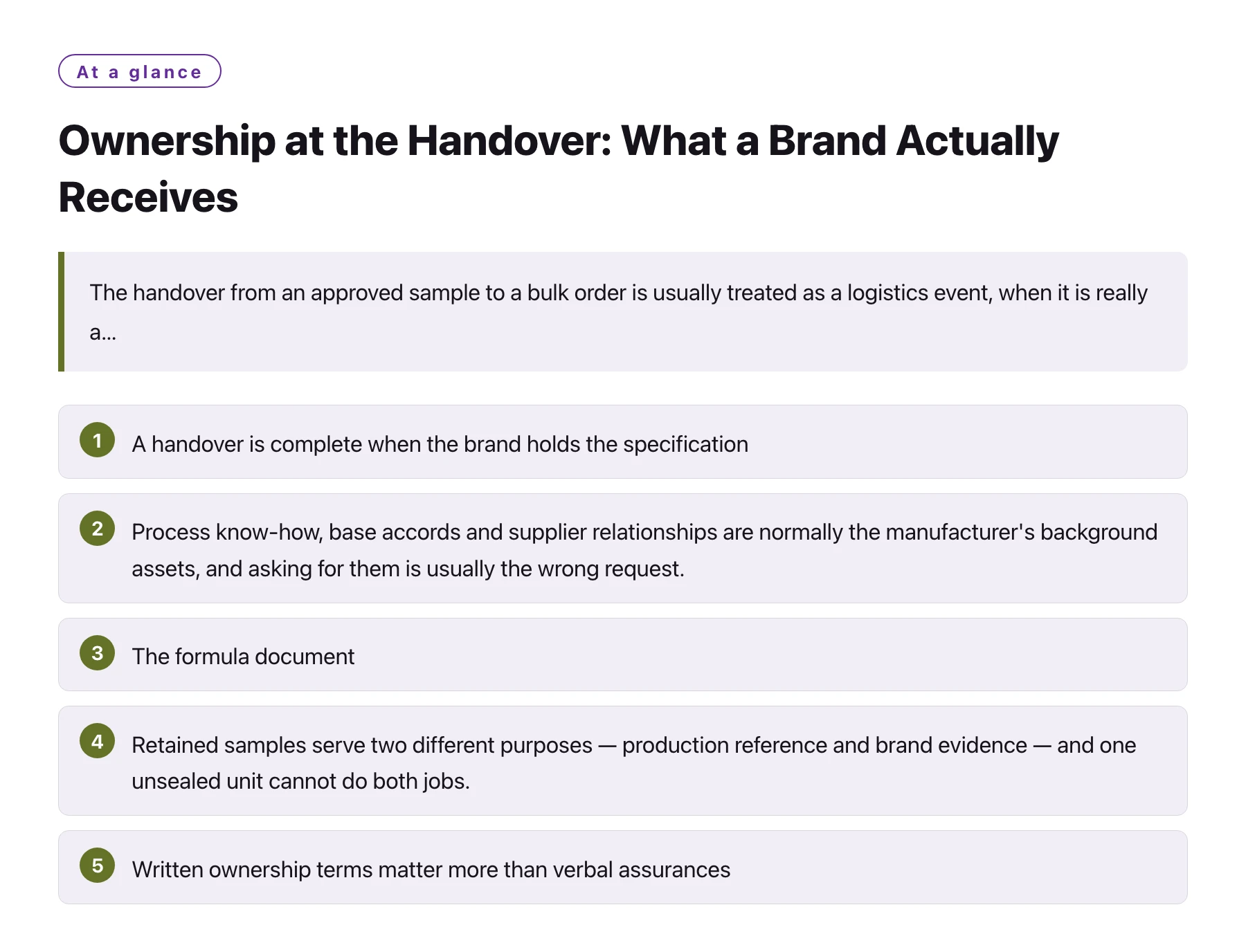
Key takeawaysA handover is complete when the brand holds the specification, the sealed reference, the artwork files and a written statement of what it owns — not when the pallets arrive. · Process know-how, base accords and supplier relationships are normally the manufacturer's background assets, and asking for them is usually the wrong request. · The formula document, the brief that produced it and the brand-facing creative work are the assets a brand can realistically expect to take with it. · Retained samples serve two different purposes — production reference and brand evidence — and one unsealed unit cannot do both jobs. · Written ownership terms matter more than verbal assurances, because industrial property can be protected through several different routes with different disclosure consequences [1]. · A handover file with a review date is what keeps ownership accurate after reformulation, a range extension or a change of supplier.
Most brands discover what they own only when they try to use it. A new contract manufacturer asks for the formula, the specification and the reference, and the brand opens a folder that turns out to contain a quotation, three sample labels and an email thread. This is a paperwork problem created months earlier, at the handover.
This article is a handover audit rather than a process guide. It lists what should change hands at the point when an approved sample becomes a bulk order, what will not change hands no matter how the contract is phrased, and how to tell the difference before you commit to volume.
It is written for an online brand owner who expects to manage the product for years, change channels, and possibly change supplier — the three situations that expose an incomplete handover.
Why the handover, not the contract, decides what you own
A contract can promise ownership in principle and still leave a brand with nothing usable, because ownership is only real when the underlying documents exist and have been transferred. A clause that says the brand owns the formula is difficult to exercise if nobody can locate the version that was actually produced, or if the only specification on file describes a scent that was superseded two sampling rounds earlier.
The handover is therefore the moment to convert legal language into files. That means naming each deliverable, checking that it exists, and confirming who holds the master copy. It is a short exercise if it happens at the right time and an expensive one if it happens after the relationship has cooled.
It also helps to understand how the manufacturer views its own role, because the answer shapes what it will hand over. A partner that presents itself as a manufacturer that supports OEM and ODM is signalling that it works in both modes, and the mode you chose determines how much of the development file exists in a form that can be transferred.
The handover ledger: what the brand receives and what stays behind
| Asset | What the brand should receive | What the factory normally retains |
|---|---|---|
| Formula record | A signed specification for the produced version, with dosage and revision date | The compounding instructions and the working method behind it |
| Reference sample | One sealed, labelled unit from the approved and produced version | Its own production reference, plus retained units per batch |
| Base accord or library material | A description of which parts of the scent are project-specific | The accord itself, and the library it belongs to |
| Analytical and safety documents | Test reports, material statements and batch certificates for the goods supplied | Internal methods, supplier qualifications and cost of testing |
| Brand-facing creative files | Artwork, dielines and print standards created for the brand | Tooling, moulds and decoration assets owned under the order terms |
| Commercial record | Written exclusivity terms with dates, channels and territories | Supplier and subcontractor relationships and pricing |
The middle column is what a handover file should contain. The right-hand column is not a list of things to demand; it is a list of things to stop expecting, so that effort goes into the parts that can actually be transferred.
Three assets brands forget to collect
The first is the version history. A scent can pass through several formula revisions during development, and only one of them was produced. Without a dated revision trail, a later comparison or an audit has no baseline, and a dispute about what was agreed becomes a dispute about memory.
The second is the label and artwork set, including the exact print standard and colour reference used on the production run. These files rarely appear on a handover list, yet they are the ones a brand needs immediately when it changes packaging supplier or adds a size to the range.
The third is the testing evidence behind any claim the brand makes on pack or online. Where a formula has been assessed for safety or compatibility, the report that supports the claim should sit in the brand's own file, not only in the factory's. Third-party testing providers describe the categories of testing available for cosmetics and personal care products, which is a useful checklist for framing the request [2].
Alongside those, the brand should record what it does not own. That sounds like a concession, but it prevents a future argument. Withholding that clarity costs the manufacturer little and saves both sides a difficult conversation.
Make the handover repeatable
A handover that works once should be written as a checklist that runs on every order. Each new production run generates a new retained reference, a new batch record and possibly a new revision, and the same folder structure should absorb them without anyone having to reinvent the process [3].
When the handover is also an exclusivity decision
Ownership and exclusivity are different questions that often arrive together. A brand can own nothing of the formula and still hold a valid exclusivity right, or own the formula outright while the contract permits the manufacturer to sell a close variant elsewhere. The handover is the moment to check that both questions have been answered in writing, with dates attached.
It is also worth knowing how other projects in the same category were structured. Manufacturer case studies are marketing material rather than contracts, but a set of the brands behind these scents can still show which combinations of ownership and exclusivity are common in your segment, which is a useful reality check before you ask for an unusual arrangement.
Where the brand intends to build a long product line, the practical target is simple: hold enough of the file that a competent third party could reproduce the product, and hold a clear written right that prevents the manufacturer from selling the same scent to a direct competitor. Everything beyond that is a commercial negotiation, not a handover requirement.
It is also worth confirming which legal entity is bound by the ownership terms, because the name on the order documents is the name that carries the obligation. Reading how Guangzhou Xuelei presents its manufacturing scope is a way to identify the operating company and what it claims to cover, but the binding version is the one in the contract, not the one on the website.
Ask for the handover pack before the bulk order is filled, not after. Once volume is committed, the brand has less leverage and the factory has other priorities. A one-page checklist signed at the point of order confirmation — specification, retained reference, artwork set, test reports, exclusivity statement — is enough, and it should be reviewed whenever the formula, the packaging or the supplier changes.
Sources
- WIPO — World Intellectual Property Organization —— The UN agency for intellectual property; resources on industrial design and patent protection relevant to product and packaging design.
- SGS: Cosmetics, Personal Care & Household Testing —— Testing, inspection and certification services for cosmetics and personal care, including microbiological, stability and safety testing aligned with cosmetics GMP.
- Cosmetics Europe —— The European trade association for the cosmetics and personal care industry, publishing guidance, positions and market information.
Frequently asked questions
Does the brand own the formula if it paid for development?
That depends entirely on the terms, and paying for development does not automatically transfer ownership. Some agreements assign the project-specific formula to the brand while the manufacturer keeps background know-how and library accords. The handover pack should state which is which in plain language.
Can a brand insist on receiving the manufacturer's base accord?
It can ask, but it is usually a request the manufacturer will refuse, because the accord is shared across many customers and is part of its competitive position. A more realistic outcome is a written description of which layers are project-specific and which are background, plus exclusivity terms on the finished scent.
How many retained reference samples should a brand keep?
At least one sealed unit per produced version, stored under the conditions the product is designed for, plus a working unit for comparison. Keeping the first approved sample alongside the first bulk reference is worthwhile, because the pair is what makes a drift discussion concrete.
What happens to tooling and moulds at the end of a relationship?
It depends on who paid for them and what the order terms say. Moulds and decoration assets are frequently retained by the manufacturer even when the brand funded them, with use restricted to that brand. If transfer matters to you, it has to be agreed before the tooling is cut.
Is a handover pack necessary for a small first order?
It is most valuable precisely there. A small brand has less leverage and fewer people to reconstruct what happened, so a compact file — specification, reference, artwork, test reports and exclusivity note — protects the next order, the next supplier conversation and any future claim.
Ready to go borderless?
Activate Teleki Blanka's global eSIM in 90 seconds. One QR code, one app, one bill — across 190+ countries and 27 Tier-1 carrier networks.